
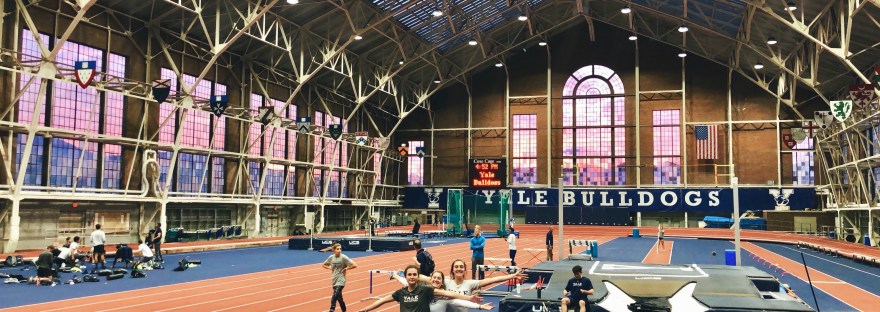
I guess it’s a good time to get back to writing. It only took me 3+ weeks to finish this note, so my original every Friday schedule might be a stretch, but this is what I have for now – a letter I wrote to my team after the rest of our season was cancelled.
Dear tYf,
I’ve spent the past weeks up and down every emotion in the book. I’ve found some solace in trying to focus on what was rather than what could have and should have been. Although this time of reflection has been difficult, I wanted to share a few things here. As I hope you all know, this team meant the world to me, and I want to articulate exactly why.
Track and field saved me two times in my life. The first came with my start as a runner. I joined the cross-country team my first year of high school. After I quit gymnastics in seventh grade, I was left with a very lonely and depressed middle school experience. Constantly compared to my thriving, college athlete, older sister, I felt so inferior. I struggled socially and felt no passion or purpose in my life.
I thought joining the cross country and track team in high school was a way to make friends. On the first day of practice, I met my high school best friend, Alice. Our friendship quickly blossomed from our first run together, and I was content with my experience in cross country as a social one. Maybe my bout as an athlete was in gymnastics, and I wasn’t meant for more. But then track season came along, and I was the only girl who could do a push-up. Weird, right? My ability to do a single push-up started my career as a multi. Don’t sleep on push-ups!
My first year as a multi was a mess. I had no idea what I was doing and was not succeeding by any means. Despite the initial failure, I loved it, and it fit my personality perfectly. I committed the rest of high school to training to be the best heptathlete I could be. I left the cross-country running by the wayside, kept the friendships, and started excelling on the track. Year by year, I improved exponentially, and my track success became my identity in my high school and across my town. In retrospect, I realize that my athletic success was in smallest part a result of my natural athleticism but in majority due to my hard work and incredibly technical and committed coach.
As I embarked on my career in college athletics, I was under the naïve assumption that training to run, jump, and throw would be the most challenging and time-consuming part of my Yale Track and Field experience. Of course, as most eighteen-year-olds are, I was wrong.
Sometimes I think about each year of college track as plagued with an asterisk, all of which caused me to underperform and not achieve my goals. My first year on the team at Yale was the opposite of what I’d expected. The workouts were easy, the team was fragmented, the energy was complacent, and my program as a mutli was logistically and technically inadequate. I competed for the last month of my first-year season on a broken ankle, but it was not until years down the line that I realized my foot was not the only thing I broke that year. My confidence was shattered, and three years later I am still painstakingly piecing it back together.
For a long time, I oscillated between blaming myself and blaming the program. Regardless of whatever I blamed, I survived on the rationale that hard work pays off. My competitiveness, once one of my greatest strengths, became my biggest vulnerability. My desire to be better and do better on the track made my mind malleable to flawed logic and unproductive cycles. Still, I somehow tricked myself into thinking I was being the best version of myself.
I came back to Yale sophomore year, greeted with praise about my fitness, a group of eager first years, and a whole new set of social dynamics. Honestly, I thought I was killing it. I felt like I had mended and strengthened friendships, and I thought I knew how to manage the track program to manifest my personal and team goals. The year ended with more women leaving the team than we would make up for the following year, and I was in a boot, having run myself into a stress fracture. I was back to playing the blame game. What could I have done to prevent this? I took a deep sense responsibility for my own shortcomings and extrapolated that pressure to the rest of the team.
Sophomore year ended with another failed attempt at my collegiate goals, so third year’s a charm, I thought, and yet again, my optimism proved unfounded. My addiction to ‘hard work’ was back, and my anxiety about track was all-encompassing. I tried my best to adjust my expectations and achieve a healthy relationship with track, but I was still fixated on the fact that I and the rest of the women on the team deserved better than what the program had to offer. I was stuck blaming the system but somehow under the unwitting impression that I had chosen to be happy and not let it affect me. My trust in the system completely broke when an encounter with a member of the men’s team uncovered problematic and disrespectful narratives that I thought were far gone in a group of people I had come to know and love. Although the relationships between our two groups had matured from pie-ing each other in the dining halls, it was still one fraught with toxic masculinity.
At that point, I couldn’t believe it. I felt like I had given everything to the team, but somehow the rain kept on pouring. That was a few weeks before the season opener, but I had spent the time I needed to struggle, be outraged, and lean on my friends to help me through it. I was fine. I thought. But by the first meet I was just exhausted – by the emotional and physical energy I had spent on Yale track and field – and absolutely heartbroken by underperforming, again. I questioned all the hours I spent in the cage, getting to practice hours before the group and still the last one to leave. Along the way my hip started to hurt and that added insult to mental and physically injury.
For a long time, I was so attached to the concept that hard work pays off. I thought I deserved to do well because I put in the time and energy. It took a long time to thaw that notion to its reality. I don’t deserve anything. Yes, I’ve worked hard, but the world is not rigged against me – it’s manufactured for people like me to succeed. I recognize the identity and mental health struggles I’ve encountered as significant but still try to reconcile perspective about the relative insignificance of track and field at Yale in scheme of my life. I’m torn between feeling guilty about the triviality of some of the challenges that shaped who I am while feeling proud of the journey that ignited my passions and life pursuits.
I could argue that this year has the largest asterisk of them all. A season cut short, closure eliminated, and celebration indefinitely pending. Objectively it does but subjectively it would be disappointing to consider what we accomplished as anything less than a success. Being elected captain of this team was the proudest moment of my life. That was the second moment track and field saved me. Despite all the challenges I faced, I never lost passion for the team and pursuit to change the culture. Every single one of us changed the culture with our actions, holding ourselves to high standards and expecting that we could be the best versions of ourselves on and off the track. Watching those behaviors come to fruition this year started sewing my confidence back together. Even though I wasn’t the one stepping out on the line achieving the goals I set forth long ago, I was empowered by the energy around me and that was enough.
I hope writing this letter is the start to saving me a third time. This year, I was the happiest I can remember. That is in every part due to this group of people I have been lucky to be a part of. We didn’t deserve the ending we got, but this is the utmost reminder to enjoy each and every rep, team dinner, and moment together. It’s time I put the blame game to bed because there are always going to be obstacles (personal and systemic) in my way, but if I’ve learned anything, it’s that the best way through it is with a group of strong, smart, and resilient by your side.
With love and empowerment,
Natasha

 fwordsonly